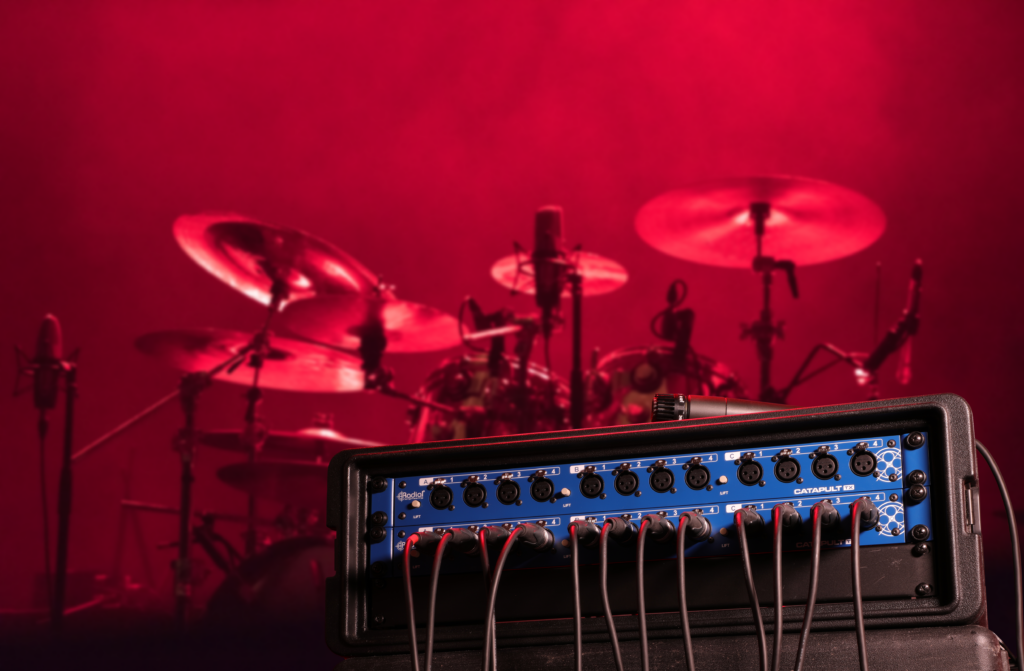
The following review by Mark Woods was originally published in Audio Technology Magazine.
Radial Engineering has a big reputation for making pro audio problem solvers. Its direct boxes (DIs) have dominated the market for some time now. Generally regarded as among the best available, the combination of high fidelity, rugged design and practical features has made them a standard request on tech riders. No one asks for other brands. Radial also make splitters, combiners, interfaces and devices that solve problems you didn’t know you had (until you have them). The Catapult Analogue Over Cat5 range is one such solution.
Cat5/Cat5e Ethernet cables and RJ45 connectors were designed for digital data transmission, not audio, but the twisted-pair cable used to reduce interference is suitable for balanced analogue audio. So with a bit of hacking they can be made into a cheap four-channel audio multicore. Radial’s first audio-over-Ethernet (AoE) product, the Radial Catapult TX4 released in 2016, turned the hacker’s idea into a road-tough device with a strong case and proper connectors. The TX4 functions as a four-channel passive splitter/Ethernet extender, available in straight-wire or TXL4 transformer-isolated versions.
BETTER TO SEND & RECEIVE
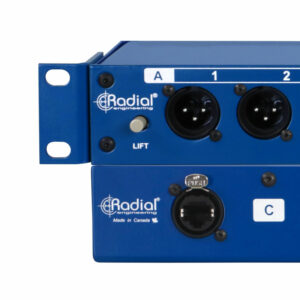
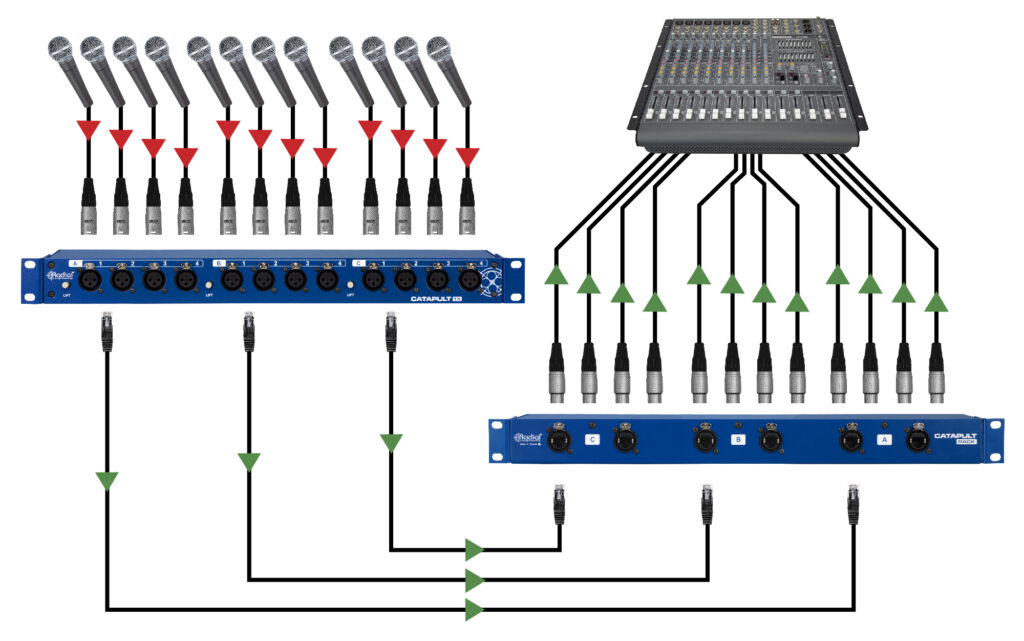
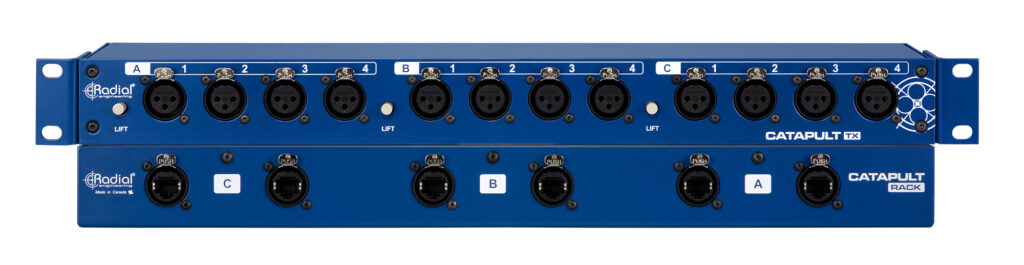
The Catapult Rack TX/RX has recently joined the Catapult range. Essentially three TX4 four-channel devices built into a single-space rack unit that handles up to 12 channels of audio over three Cat cables. A simple device built with typical Radial strength and attention to detail, the distinctive blue colour looks good in the rack and the clear layout helps when making connections. The Catapult TX front panel has three sections (A, B, C) of 4 x Neutrik XLRs and a ground lift. The rear panel has six locking EtherCon RJ45 sockets, two for each section. The matching Catapult RX version is the same except for the gender of the XLR sockets. Reversible rack ears allow you to mount the Catapult either way in a rack.
STRANDS
Instinctively, the wire inside Ethernet cables looks a bit thin, in use, you don’t notice any sound issues although there is the possibility of crosstalk if there are large differences in signal levels through the same cable. Any ol’ Cat5 cable will work but shielded cable works best for optimal noise performance, or when phantom power is applied to the channel – shielded Cat6 cables will perform even better.
WORKING UNDERCOVER
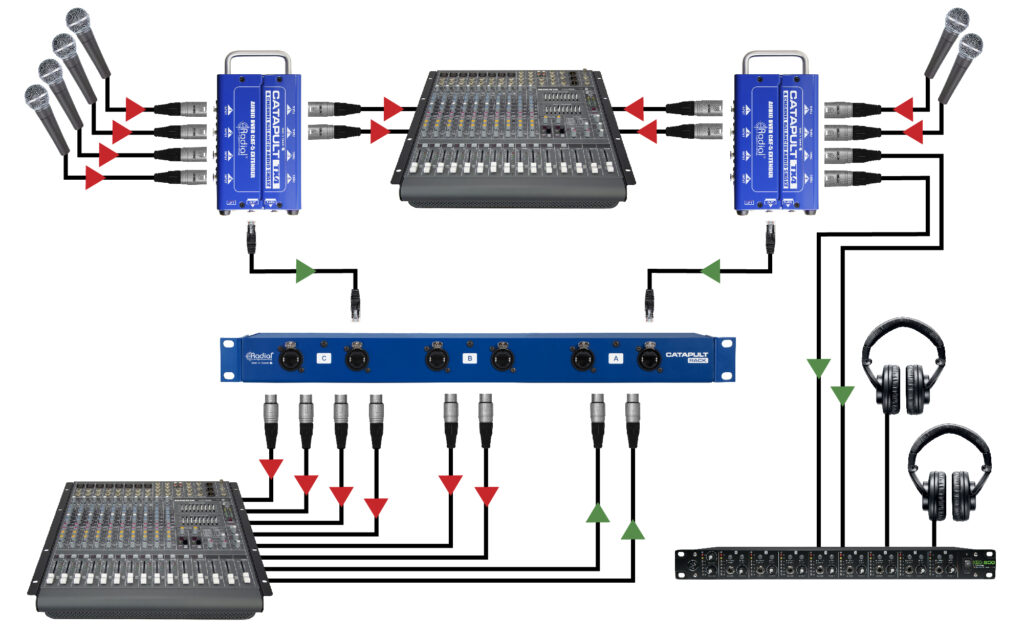
I’ve noticed the touring bands I work with at the Theatre Royal are increasingly using AoE setups for sub-snakes around stages – some acts making custom versions for each stage position. They’re neat, flexible and quicker to set up/tear down than bulky regular cabling. I installed temporary Catapult Racks at the FOH and foldback desks and used the spare house Cat5e cable to send extra mixes back to stage for a show that needed them, and it saved running a 30m return loom and worked without any issues.
Temporary long cable runs for outdoor shows is another helpful application. If the multicore is run on the ground under cable covers and you need extra channels, the Cat cables will always fit under the covers, an extra snake may not. Delay speakers or distributing sound to different parts of a small festival often sees me stringing cabling through trees or on poles to keep them off the ground… hard to do with a long, heavy multicore, much easier with Cat cables. Once you start using Catapult you see more potential applications – cue systems, temporary feeds, handy splits in venues and portable recording in remote locations to name a few.
CIRCLE BACK TO RADIAL
Because I’m sure ‘they’ are watching me I’m suddenly and mysteriously being offered lots of cheap versions of AoE connectors online. Why choose Radial Catapult devices? Quality. They’re not cheap but they are so well made they still offer good value for pro users who want flexibility, consistent functionality and high reliability. The Radial Catapult Rack is a great way to get 12 extra AoE channels in a convenient 1RU rack unit.
CATAPULT IN A NUTSHELL
The Radial Catapult does not convert audio into digital packets; instead, it uses the four twisted pairs of conductors within standard Cat5 or Cat6 Ethernet cable to transmit four channels of balanced analogue audio.
Why is Catapult ‘Analogue Audio over Ethernet’
- Physical Medium: It uses standard RJ45 connectors and Cat5/6 Ethernet cables instead of a heavy analogue multi-pair snake cable.
- Passive Operation: The system is completely passive, requiring no power, and acts as a direct ‘straight-wire’ connection, maintaining analogue audio throughout the entire chain.
- Isolated Channels: High-quality transformers are often used to break ground loops, providing clean, analogue signal transmission.
Important Distinctions
- No Digital Conversion: Unlike Dante or networked audio systems, there is no latency, no sample rate, and no A/D-D/A conversion.
- No Network Functionality: Do not connect Radial Catapult units to network switches, routers, or PoE devices, as this can damage the equipment. It uses the cable, not the network protocol.
- Limited Distance: While it can run 100+ metres, it is a point-to-point analogue snake, not a networked node.
NEED TO KNOW
Radial Catapult
Cat5 Analogue Audio Snake
PROS
- Well-built with typical Radial durability
- Delivers 12 channels of clean analogue audio over three standard Cat 5/6 cables in a compact 1RU package
- Excellent noise rejection and ground-lift switches on each bank
- No power required
CONS
- Not the cheapest AoE solution on the market
SUMMARY The Radial Catapult Rack TX/RX turns ordinary Cat 5/6 Ethernet cable into a tough, reliable 12-channel analogue audio snake. Built with Radial’s signature quality and road-ready construction, it offers a simple, passive, low-latency way to distribute audio in touring, festival, theatre and installation environments. While not the lowest-cost option, the combination of performance, flexibility and long-term reliability makes it a smart choice for professional users who value problem-solving gear that just works.